Automotive finance teams can measure almost everything about a customer communication.
An email was delivered. A customer opened it. They watched 73% of a video. They clicked a button. They visited a portal.
Those numbers matter.
But there is a much harder question behind them:
Did the communication change anything that mattered to the customer or the business?
That distinction is becoming increasingly important in automotive finance.
J.D. Power’s 2025 U.S. Automotive Finance Digital Experience Study found that a strong digital experience is becoming an important component of customer retention. It also found that customers who have stronger experiences with a lender’s website or app are much more likely to use those digital channels again.
Information and content are among the dimensions J.D. Power evaluates, alongside navigation, speed and visual appeal.
The previous year’s study went further, arguing that automotive finance digital properties should help create ongoing two-way customer communication while improving satisfaction and reducing cost-to-serve.
This creates an important challenge for marketing, CRM, customer experience and lifecycle teams in the industry.
If you invest in better automotive finance customer communication, how do you prove that it was worth doing?
The answer is not to stop measuring engagement. Instead, it is to connect engagement to what happens next.
A useful measurement model is:
Communication → Customer Action → Operational Outcome → Commercial Outcome
Engagement tells you whether the communication landed.
Customer behavior tells you whether it mattered.
The business outcome tells you whether the change may have been worth the investment. And, at a practical level, this is what we care about when we talk about personalized video to support automotive finance customer communications.
Key takeaways
- Automotive finance customer communication should be measured against the behavior it is designed to influence, not engagement alone.
- Email opens, video plays, completion rates and click-through rates are useful leading indicators. They do not automatically demonstrate ROI.
- Stronger KPIs move closer to the desired customer action: portal registration, payment setup, self-service, lease-end response or renewal initiation.
- Operational outcomes such as fewer avoidable support contacts and greater digital self-service can help build the financial case for better communication.
- Establish a baseline before changing the communication. Otherwise, it becomes difficult to distinguish improvement from activity.
- A pilot does not need to prove every downstream financial outcome. It should reduce enough uncertainty to justify—or reject—the next investment.
- Personalized video can be useful when customer data changes what should be explained and what the customer should do next. It is not the answer to every customer experience problem.
What should better automotive finance customer communication actually change?
“Improve engagement” sounds like a reasonable campaign objective. And it is one of the most common requests we get at Pirsonal.
But, in my experience, it is usually not specific enough to build a business case.
A more useful starting point is to ask:
What is the customer not doing today that better communication could reasonably help them do?
For example, an automotive finance provider may discover that:
- New customers do not register for digital account servicing.
- Customers repeatedly contact support to clarify agreement information.
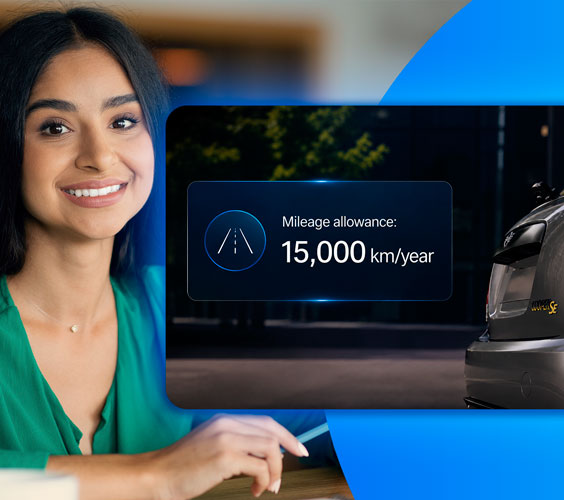
- Important mileage information gets overlooked.
- Customers wait too long to consider lease-end options.
- Renewal communications get attention but limited response.
- Customers continue using more expensive assisted-service channels when they could self-serve.
Now the communication has a job.
The table below illustrates the difference.
| Customer moment | Current problem | Customer behavior to change | Potential business effect |
|---|---|---|---|
| Onboarding | Customers are unclear about what happens next | Register and use digital servicing | Greater self-service adoption |
| Agreement information | Customers need additional clarification | Understand information and self-serve | Fewer avoidable enquiries |
| Payment setup | Customers do not adopt the desired payment method | Complete payment/autopay setup | More efficient servicing |
| Mileage communication | Relevant information is overlooked | Review usage and take appropriate action | Fewer late surprises or disputes |
| Lease end | Customers delay making a decision | Select a next step earlier | More renewal or upgrade opportunities |
| Renewal | Communications generate limited response | Start the renewal journey | Potential retention improvement |
This is an important distinction.
The purpose of better communication is not simply to make a communication perform better. It is to help a customer understand enough to make the right next move.
In my view, that also means not every communication problem deserves a complex new campaign. And this is especially true when it comes to personalized video campaigns.
if customers already understand a message and reliably take the desired action, improving it may create little incremental value that is more difficult to justify internally.
Therefore, start where misunderstanding, inaction or friction already has a consequence.
Which KPIs should automotive finance teams measure?
Different metrics answer different questions.
For example, an open rate is not a bad KPI. Neither is video completion rate or CTR.
However, the problem begins when a communication metric is expected to prove a business result it cannot prove.
A more useful approach is to separate measurement into four levels.
1. Communication metrics: Did the message get attention?
These are the metrics marketing teams already know well:
- Delivery rate
- Email open rate
- Video play rate
- Video completion or watch depth
- Click-through rate
- Landing-page engagement
They answer questions such as:
- Did customers receive it?
- Did they look at it?
- Did the communication hold their attention?
These metrics are extremely useful for diagnosing communication performance.
But they usually cannot tell you whether the underlying customer problem improved.
2. Customer-action metrics: Did the customer do something differently?
This is the next level. Here is when things start getting interesting.
Depending on the customer journey, an automotive finance team might measure:
- Digital account registration
- Payment or autopay setup
- Document review
- Appointment booking
- Lease-end option selection
- Contact with the appropriate team
- Renewal initiation
- Use of a self-service feature
- Service or product upgrade information request
These metrics bring the measurement closer to the purpose of the communication.
For example, if an onboarding campaign exists partly to increase portal usage, portal registration is a stronger business-case metric than video completion.
The video completion rate still matters. It helps explain why portal registrations may have changed.
But portal registration is closer to the behavior the organization wanted to influence.
3. Operational outcomes: Did that behavior improve the servicing model?
The next question is whether the change in customer behavior created an operational difference.
Possible outcomes include:
- Fewer repetitive support enquiries
- Greater digital self-service adoption
- Fewer missed customer actions
- Less manual intervention
- Reduced clarification volume
- Earlier customer decisions
- Lower assisted-service demand
This matters because communication can create value without directly generating revenue.
For example, J.D. Power has previously highlighted the relationship between stronger automotive finance digital experiences, greater self-service and the opportunity to reduce cost-to-serve.
That gives teams another way to think about communication performance.
So, from this perspective, the question becomes less:
“How many people clicked?”
and more:
“What happened because they clicked?”
This is a braver question. And braver mindset.
You’re already starting to move away from implementing, for example, personalized videos in financial services simply to impress customers, and instead supporting much more specific objectives beyond an AI trend.
4. Commercial outcomes: Was measurable value created?
Finally come outcomes such as:
- Renewal
- Retention
- Upgrade
- Revenue retained
- Servicing savings
- Cost-to-serve reduction
- Greater customer lifetime value
These are naturally attractive metrics. They are also the ones where attribution becomes more difficult.
Why? Well, a customer may renew because of price, vehicle availability, dealer experience, product satisfaction, personal circumstances and dozens of other variables—not because of one communication.
So the goal should not be to force every campaign into a simplistic attribution model.
However, if you are working with segments or cohorts, it should be easy to compare how much one type of communication contributed to the change in contact behavior.
Therefore, build a credible chain of evidence.
| Automotive finance moment | Don’t stop measuring at | Stronger outcome to investigate |
|---|---|---|
| Onboarding | Email opens or video plays | Digital account activation |
| Payment setup | CTR | Payment/autopay completion |
| Agreement explanation | Watch rate | Related support enquiries |
| Mileage communication | Opens | Appropriate customer action |
| Lease end | Engagement | Next-step selection or appointment |
| Renewal | CTR | Renewal initiation or retention |
| Support education | Video plays | Self-service or contacts avoided |
The closer a metric gets to the customer behavior you intended to change, the more useful it becomes for the business case.
How do you connect customer communication to business value?
This is where many measurement plans become either too vague or too ambitious.
One side reports campaign engagement and stops there.
The other tries to attribute a financial outcome directly to the communication without proving the steps in between.
A better approach is to make the hypothesis explicit:
Communication → Customer Action → Operational Change → Business Value
Consider three examples.
Example 1: Digital self-service
Suppose new customers frequently contact support for information already available in the customer portal.
A better onboarding communication could be designed to explain what the customer can do digitally and lead them directly to registration.
The hypothesis becomes:
Clearer onboarding communication
→ more portal registrations
→ more customers self-serving
→ fewer assisted-service interactions
→ potential reduction in servicing cost
Each step can potentially be measured.
If the communication receives excellent engagement but portal registrations do not move, the team has learned something important.
Perhaps the message was interesting but ineffective.
Perhaps registration itself is difficult.
Perhaps the communication is solving the wrong problem.
That is useful evidence too.
Example 2: Agreement information and support
Imagine a customer segment frequently contacts the service team to clarify a particular aspect of their agreement.
A communication could explain that information using account-specific context.
The measurement chain might be:
More relevant or easier-to-understand explanation
→ customer reviews information
→ fewer clarification enquiries
→ reduced assisted-service demand
→ potential cost-to-serve benefit
The important word here is potential.
You should measure the downstream effect instead of assuming it.
Better communication cannot fix an underlying process that is unnecessarily complicated.
Example 3: Lease-end and renewal
Lease-end communication has a different economic hypothesis.
For example:
Relevant lease-end communication
→ customer considers options earlier
→ more customers choose a next step
→ more renewal or upgrade conversations
→ potential retained customer value
This does not mean the communication “caused” every eventual renewal.
It means the team has created a measurable path between communication and a commercially relevant behavior.
That is much more useful than trying to jump directly from an open rate to revenue.
How do you calculate ROI from customer communication?
There is no universal ROI benchmark for automotive finance customer communication.
The calculation depends on the problem being addressed.
However, a few simple and common models can help determine whether a project deserves further investigation.
Support or servicing value
A basic model could be:
Avoidable support contacts reduced × estimated cost per contact
If the new experience reduces a recurring type of enquiry, the organization can estimate the operational value associated with that change.
Digital self-service value
Another model could be:
Additional customers using self-service × estimated difference in servicing cost
Again, the organization needs its own numbers.
Industry benchmarks can provide context, but an internal business case is stronger when it uses the lender’s actual servicing economics.
Renewal or retention value
For a renewal communication, an initial model might be:
Additional customers entering the renewal journey × historical conversion rate × estimated retained customer value
This should be treated as a model for evaluating the opportunity, not a promise that the communication will generate that value.
When reliable incremental value and program cost can be estimated, a traditional ROI calculation can then be applied:
ROI = (incremental value − incremental cost) ÷ incremental cost
The difficult part is not the equation. It is establishing a credible incremental value.
That is why the behavioral and operational evidence matters so much.
Why do you need a baseline before changing the communication?
Suppose a new onboarding communication gets 20% of customers to register for the portal.
Is that good?
You can’t know from the 20% alone.
If the current communication gets only 4% to register, the new approach may represent a significant improvement. If the current communication already gets 24%, the new approach may actually be performing worse.
That is why you need a baseline: a clear picture of what customers do today before you change the communication.
Depending on the use case, that baseline might include the current action rate, support enquiries, self-service adoption, renewal response, or other behavior you are trying to improve.
Before launching, establish as much of the current state as reasonably possible.
Depending on the use case, that may include:
- Segment
- Number of customers receiving the existing communication
- Existing engagement rate
- Existing customer-action rate
- Time required to complete the desired action
- Related customer-service enquiries
- Existing digital/self-service adoption
- Manual servicing activity
- Renewal or retention behavior
- Complaint or clarification volume
You do not need perfect measurement before starting. Most organizations do not have it.
But you need enough of a baseline to answer a basic question afterward:
Did something meaningful change?
Without a baseline, improvement becomes an opinion.
What should an automotive finance communication pilot prove?
A pilot is sometimes expected to do too much.
Teams want it to prove engagement, ROI, technical scalability, customer satisfaction, operational savings and long-term retention—before the full program even exists.
That can make the pilot unnecessarily complicated.
A better pilot reduces uncertainty and clarifies next steps.
For example, it may help answer:
- Did customers engage differently with the new communication?
- Did more customers take the intended next action?
- Did customer-specific information make the explanation more useful?
- Can the workflow be executed reliably?
- Is the effect measurable against the existing baseline?
- Is there enough evidence to investigate the downstream business outcome?
Therefore, the purpose of a pilot is not to prove everything. It is to reduce enough uncertainty to make the next decision intelligently.
Do you need CRM or API integration for the pilot?
Not necessarily.
For example, in personalized video communications, many the fastest way to test a communication is to use data the team can already export securely into a controlled batch process.
A spreadsheet-based workflow is not automatically unsophisticated.
If it allows the organization to validate the message, customer behavior and measurement model before committing IT resources, it may be exactly the right first architecture.
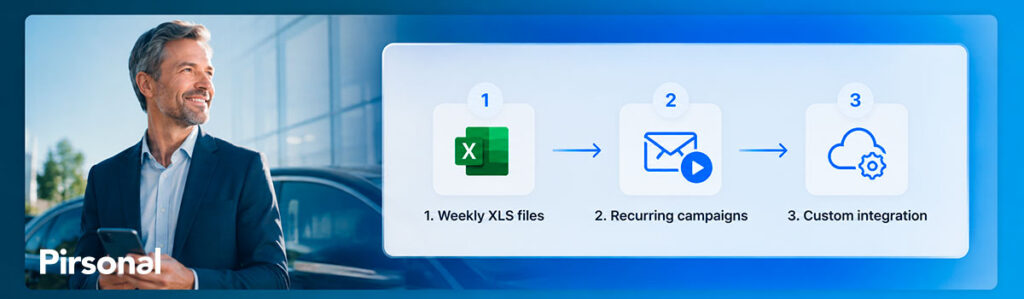
We have seen this progression firsthand at Pirsonal.
One automotive finance company has used personalized video in its customer communications for years. The program began with weekly XLS files containing the information needed to generate customer-specific experiences. As the recurring program matured, the workflow eventually evolved into a custom integration. The case study reports email open rates around 70% and click-through rates of approximately 25%.
Those are strong engagement signals.
They are not, by themselves, proof that personalized video caused every downstream renewal, customer-satisfaction or servicing outcome associated with the wider program.
That distinction matters.
If we were defining the measurement plan today, we would want to connect those engagement signals more explicitly with the behavior each communication was intended to change.
Where can personalized video improve automotive finance customer communication?
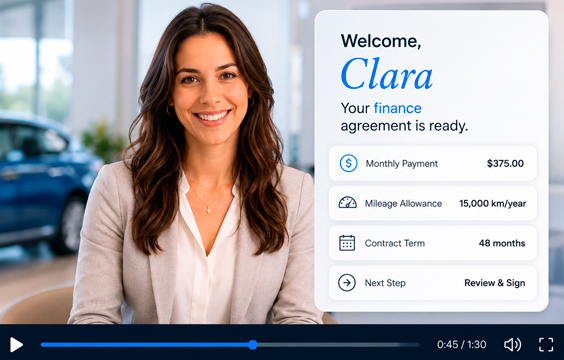
Personalized video is most useful when customer-specific information materially changes the explanation.
Not when the only personalization is:
“Hello, Clara.”
A stronger use case exists when knowing something about the customer’s agreement, product, status, milestone or behavior allows the communication to answer questions such as:
- What matters to this customer?
- Which information needs explanation?
- What does it mean in their situation?
- What should happen next?
- Which action is appropriate now?
That can be useful during onboarding, agreement communication, mileage updates, payment-related moments, lease end, renewal and other lifecycle communications.
The technology can sit inside the systems the organization already uses.
A simplified model might look like this:
CRM / customer data
determines context and audience
↓
Personalized video
adapts the explanation
↓
Email / SMS / app / portal
delivers the experience
↓
CTA / customer system
enables the next action
This is an important architectural distinction.
Personalized video does not need to become another channel competing with the lender’s website, app, email program or CRM.
It can become an explanation layer inside the existing customer journey.
The opportunity is especially relevant because customers increasingly expect coherent digital experiences across touchpoints.
For example, in a 2024 study of 1,009 automotive finance customers in Germany, Genpact and horyzn.io found that 64% preferred digital channels across the customer lifecycle, while actual usage of apps and portals was below 18%. The same research found that 44% of customers were not aware of having received an end-of-term offer.
That does not mean personalized video solves either problem automatically.
It does show why sending information and changing customer behavior are different challenges.

Build the Business Case for Your Personalized Video Campaign
Before you launch, get clear on what customer behavior should change, what you’ll measure, and what result would justify the investment. Use this worksheet to plan a personalized video campaign your team can evaluate—and confidently scale if it works.
When is personalized video not the answer?
This deserves as much attention as when it is useful.
Personalized video probably should not be the first intervention if:
- Customer data is generally wrong.
- Customers cannot log into the portal.
- The underlying process is unnecessarily complicated.
- The offer itself is weak.
- Pricing creates the objection.
- The required customer action is difficult to complete.
- A simple transactional message already produces the desired behavior.
Better communication should not be used to disguise a broken customer experience.
If the customer watches a perfectly personalized explanation and then lands on an unusable process, the communication has merely delivered them to the next problem more effectively.
Fix the right problem.
What should automotive finance teams consider before scaling?
Once a pilot shows promise, the question changes.
It is no longer:
“Can we do this?”
It becomes:
“Should this become part of our operating model?”
Three areas matter.
1. Economics
Did enough customer behavior change to justify continued investment?
Can the organization connect that change to an operational or commercial outcome worth pursuing?
2. Operations
Is the communication recurring?
Does scale make spreadsheet or manual campaign management inefficient?
Does timing matter enough that CRM, API or event-driven automation would improve the experience?
Automation becomes valuable when it scales something that has already demonstrated a reason to exist.
Automate a personalized video communication because it has earned repetition—not simply because integration is technologically possible.
3. Governance, security and compliance
Automotive finance operates in a regulated environment.
Teams need to establish:
- Which customer data is actually necessary
- How that information will be protected
- Which elements of the communication can vary
- Which messaging requires approval
- How personalized variations are governed
- Who can access customer data
- How communication and customer behavior are monitored
- Which contractual or required communications remain separate
In some markets, customer understanding is itself an important regulatory consideration.
For example, the UK’s FCA Consumer Duty rules require firms, where appropriate, to tailor communications with regard to customer characteristics, product complexity and communication channels, and to monitor whether communications support good customer outcomes.
Personalized video can help explain and contextualize information.
It should not automatically be treated as a replacement for contracts, legally required disclosures or regulated notices.
Automotive finance customer communication business-case checklist
Before proposing a new communication program internally, try answering these ten questions:
- Which customer moment are we trying to improve?
- What is going wrong today?
- What should the customer understand or do differently?
- What is our current baseline?
- Which communication metrics will tell us whether the new experience gets attention?
- Which customer-action metric tells us whether behavior changed?
- Which operational or commercial outcome could that behavior affect?
- How could we estimate the value of that change?
- Can we test the hypothesis without unnecessary technical complexity?
- What evidence would justify scaling, automating or stopping the program?
If you can answer those questions, you have something more useful than an idea for a more engaging campaign. You have the beginning of a defensible business case.
At Pirsonal, we help automotive finance and other customer engagement teams evaluate the communication, available customer data, desired behavior and implementation model before turning it into personalized video at scale.
Sometimes that means starting with a controlled campaign.
Sometimes it means building a recurring automated workflow.
And sometimes the right conclusion is that personalized video is not the first thing that needs fixing.
The objective is not to create more videos. It is to make an important customer communication easier to understand, easier to act on and valuable enough to justify doing at scale.
See the automotive finance personalized video case study →