Most teams see Spotify Wrapped and ask:
Can we create something like this?
But the better question is:
Should we?
A Spotify Wrapped-style campaign can be powerful when your audience has meaningful personal, customer, member, partner, donor, student, employee, or impact data—and when that data can help them understand something valuable about their own role, progress, contribution, or results.
But it is not the right format for every campaign.
If the data is weak, the message is not important enough, or there is no clear next action, a simpler email, PDF report, dashboard, or landing page may be enough.
The real question is not only whether you can deliver the data. It is whether the data will resonate.
This guide helps marketing, membership, partner, lifecycle, and customer engagement teams decide when a Spotify Wrapped-style personalized video campaign is worth building — and what to prepare before starting.
Editor’s note: This guide is based partly on Pirsonal’s work with Sustainable Salons and a recorded conversation between Josías De La Espada and Lucy O’Keeffe, Marketing Manager at Sustainable Salons. Watch the full conversation below:
Key Takeaways
- A Spotify Wrapped-style campaign is worth building when the audience needs to understand personal value, progress, contribution, performance, or impact.
- The main challenge is not data delivery. It is data resonance: helping people understand why the data matters to them.
- Personalized video is useful when static formats do not create enough context, recognition, emotional connection, or action.
- B2B2C, membership, and partner teams are especially strong fits because recipients often need to understand the story and share it outward.
- The best campaigns need meaningful data, a clear story, a personal viewing experience, a CTA, QA, and the right delivery/security model.
- Sensitive or regulated data does not automatically rule out personalized video. It requires the right data handling, hosting, access, and delivery approach.
What Is a Spotify Wrapped-Style Campaign?
A Spotify Wrapped-style campaign is a personalized recap experience that turns individual, account, member, partner, customer, donor, student, or employee data into a clear story about that person’s progress, contribution, value, impact, or next step.
The format can include personalized videos, personalized landing pages, downloadable assets, interactive CTAs, email, SMS, WhatsApp, direct mail QR codes, or CRM-triggered messages.
The goal is not to copy Spotify’s design.
The goal is to help each person see something meaningful about themselves inside the data.
Short Answer: When Is a Spotify Wrapped-Style Campaign Worth It?
A Spotify Wrapped-style campaign is worth it when your team has meaningful audience data, but the real challenge is not simply sharing that data.
It is worth considering when members, partners, customers, donors, students, employees, or other audiences need to understand what the data means in their own context—their value, progress, contribution, impact, or next step.
It is usually not worth it if the campaign only exists to copy a trend, if the data is unreliable, or if a simple email, PDF, dashboard, or report would already create enough understanding and action.
| Create a Spotify Wrapped-style campaign if… | Do not create one if… |
|---|---|
| The audience needs to understand personal value, progress, contribution, or impact | The message is simple and already clear |
| The data is meaningful and reliable | The data is weak or incomplete for most contacts |
| The campaign supports renewal, sharing, participation, engagement, education, or action | The only reason is to copy Spotify’s visual style |
| A static report would not create enough recognition or understanding | A PDF, email, dashboard, or landing page is enough |
| There is a clear next action | There is no clear CTA |
| Your team can review and approve the data before launch | Nobody owns data accuracy or QA |
| The experience needs to feel personal and contextual | The audience does not need personal context |
In our experience working with marketing teams, the best campaigns do not start with the format.
They start with a question:
What do we need this audience to understand, feel, or do?
Why Most Marketing Teams Should Not Start by Copying Spotify
Spotify Wrapped is a brilliant marketing campaign because it makes personal data easy to understand, easy to recognize, and easy to share.
But most teams should not begin by trying to copy Spotify’s design.
Your audience probably does not care about listening minutes, top artists, or favorite genres.
They may care about something else entirely:
- What value they received from your product or service.
- What progress they made.
- What impact they helped create.
- What they contributed to a broader community.
- What their customers, members, or stakeholders should know.
- What they should do next.
That is why the best question is not:
How do we make our version of Spotify Wrapped?
The better question is:
What meaningful data do we already have that our audience would care about if we helped them understand it better?
The format is familiar, but the job is different
Spotify’s audience is made of individual users reflecting on their own listening behavior.
Your audience may be very different.
You may be communicating with:
- members of a sustainability program
- customers before renewal
- partners in a channel program
- donors who contributed to a cause
- franchisees or local operators
- students who need to complete next steps
- employees reviewing benefits, learning, or milestones
- loyalty members receiving a recap of their activity
- advisors, dealers, or agents inside a larger network
The campaign should be designed around the audience’s job-to-be-done, not Spotify’s visual identity.
The real mechanism is recognition, not imitation
The strongest campaigns do not copy Spotify’s look. They copy the underlying mechanism. How? Turning personal data into recognition.
A strong recap campaign does not simply show people numbers. Instead, it helps them think:
This is about me.
I understand what I achieved.
I can see the value.
I know what I helped make possible.
I know what to do next.
That is the difference between a personalized data display and a personalized campaign that actually moves people. This is the approach we recommend to our clients at Pirsonal.
Vanity recap campaigns fail when the data does not matter
This is the clear pattern we’ve seen since 2017: a campaign can look dynamic, colorful, and personalized can still fail.
This usually happens when the data is technically personalized but not emotionally or practically meaningful.
For example, a campaign may fail if:
- the viewer does not recognize the data or context
- the numbers feel random
- the story has no clear point
- the message does not connect to the viewer’s reality
- the CTA is weak or missing
- the campaign does not support a real decision, behavior, or business goal
Therefore, a Spotify Wrapped-style campaign should not be a design exercise. Instead, it should be a relevance exercise.
Why Member, Partner, and B2B2C Marketing Teams Are Especially Well Suited
This type of campaign is really powerful in B2C, B2B, and B2B2C marketing. But it is especially useful for teams that need members, partners, customers, donors, franchisees, advisors, dealers, local operators, or community participants to understand their own role in a larger story.
That is why this approach can be a strong fit for marketing, membership, partner, lifecycle, loyalty, sustainability, and customer engagement teams.
These audiences often need to understand their role in a larger story
Year-in-review video campaigns activate four of the strongest motivators in customer psychology. Members, partners, and B2B2C audiences often belong to a larger system.
They may need to understand:
- what they contributed
- what they achieved
- how they participated
- how their activity connects to a broader mission
- what value they received
- what impact they helped create
- what next step they should take
This is different from simply sending an update.
The goal is to help the recipient understand their own place in the bigger picture.
The data is often meaningful, but hard to communicate
Many teams already have meaningful data. The problem is that the data is often dense, fragmented, or difficult to translate into a clear message.
For example:
- A sustainability program may have impact metrics by member or location.
- An association may have participation or member value data.
- A partner program may have performance and engagement data.
- A franchise network may have local achievements or milestones.
- A donor organization may have contribution and impact data.
- A customer success team may have account usage or value data.
A report may contain the facts. But the reader may not feel the personal meaning.
That is where a personalized recap experience can help.
The recipient may need to share the story outward
This is one of the biggest opportunities in B2B2C marketing. In many year-in-review campaigns, the direct recipient is not the final audience.
They may need to share the story with their own customers, community, team, stakeholders, or network.
For example:
- a salon may want to share its sustainability impact with customers
- a franchisee may want to show local progress
- a partner may want to communicate program results
- an association member may want to show why they belong
- a donor may want to share what they helped fund
- a local operator may want to show community contribution
In B2B2C, the personalized recap does not only communicate value. It helps the recipient carry the value forward.
The 5-Question Fit Test for Personalized Year-in-Review Videos
Before creating a Spotify Wrapped-style campaign, use this five-question fit test.
It will help you decide whether personalized video is the right format or whether a simpler communication would be enough.
1. Do you have meaningful audience data?
Meaningful data is not just data you can personalize. It is data the viewer can recognize within their individual context, understand, and care about.
Examples include:
- account name
- customer name
- member name
- membership year
- location
- segment
- contribution
- usage
- progress
- participation
- savings
- milestones
- performance
- impact
- next recommended action
The key question is:
Would the recipient look at this data and think, “This is about me”?
If the answer is yes, the data may be strong enough to support a personalized recap. Even if the personalization is not obvious.
If the answer is no, the campaign may feel like decoration rather than relevance.
2. Does the audience need to understand value, progress, contribution, or impact?
A personalized recap works best when the data helps answer a deeper question.
For a customer, that question might be:
What value did we actually receive?
For a member:
What did my business contribute?
For a donor:
What did my giving help make possible?
For a partner:
How did we perform, and what should we do next?
For a student:
What progress have I made, and what is my next step?
For an employee:
What did I complete, choose, or achieve?
This matters because the goal is not to show data for its own sake. The goal is to help the audience understand something important about their own relationship with your brand, product, service or organization.
3. Is the challenge data delivery or data resonance?
This is one of the most important questions.
Data delivery means the information reaches the audience. Data resonance means the audience understands why the information matters to them.
Many teams solve delivery but fail at resonance.
They send the email. They attach the PDF. They publish the dashboard. They create the report. They post the social tile.
But the audience still does not fully understand the value, contribution, progress, or impact in their own context.
A Spotify Wrapped-style campaign becomes more useful when the challenge is not simply:
“Can we share the data?”
But:
Will this audience understand why the data matters to them?
This is where personalized video can do a better job than a static format. Video gives the message sequence, emotion, explanation, and context.
Video personalization makes that context specific to the viewer.
4. Is there a clear next action after the recap?
A personalized recap video should not end with:
“Nice video.”
It should support a clear next step.
That next step might be:
- download the video
- share the recap
- renew membership
- register for a program
- donate again
- complete a required step
- read the full report
- book an account review
- talk to a representative
- continue participating
- invite others to join
The stronger the CTA, the easier it is to measure whether the campaign worked.
Before building the campaign, ask:
What should the viewer do after they understand the story?
5. Can your team review the data, experience, and delivery path before launch?
Personalization increases relevance, but it also increases the need for accuracy.
Before launching, your team should know who owns:
- data review
- data mapping
- missing value rules
- brand alignment
- fallback values
- test videos
- test landing pages
- CTA checks
- link testing
- delivery channel review
- access and security review
- stakeholder approval
- final QA
For serious campaigns, this is not optional.
If the campaign includes customer, member, financial, employee, student, or impact data, accuracy and trust matter. The goal is to create a personal experience that feels relevant, helpful, and safe.
What Data Do You Need for a Customer, Member, or Partner Recap Video?
You do not need hundreds of data points to create a strong personalized recap video. In many cases, a small number of meaningful fields is enough.
The best data is not always the most impressive data. It is the data that helps the viewer understand something meaningful about their relationship with your organization. It is the data they can’t easily figure out on their own.
Data for customer value recaps
Customer value recaps are useful for SaaS, financial services, insurance, education, loyalty, lifecycle marketing, customer success, and account management teams.
Useful CRM or contact fields may include:
- customer or account name
- product usage
- adoption metrics
- completed actions
- savings
- milestones
- activity
- renewal timing
- progress
- team usage
- recommended next step
The goal is to help the customer understand value.
Not generic value.
Their value.
Data for member impact recaps
Member impact recaps are useful for associations, membership programs, sustainability programs, communities, and networks.
Useful fields may include:
- member name or account name
- membership year
- segment
- location
- participation
- contribution
- impact metrics
- community results
- shared achievements
- next action
The goal is to help members see their own role in the larger mission.
Data for partner, franchise, or dealer recaps
Partner recap video can support partner marketing, channel teams, franchise groups, advisor networks, dealer networks, and local operators.
Useful fields may include:
- partner or location name
- growth
- performance
- leads
- sales activity
- engagement
- training completion
- milestones
- opportunities
- next recommended action
The goal is often to create a better business conversation.
It can help partners understand what happened, what it means, and what they should do next.
Data for donor, student, or employee recaps
Other personalized recap videos campaigns may use different kinds of data.
For donor campaigns:
- donation impact
- project supported
- people helped
- geography
- campaign participation
- next giving opportunity
- progress
- pending steps
- course or application milestones
- deadlines
- enrollment actions
- next recommended step
- training completed
- benefits selected
- milestones
- participation
- recognition
- deadlines
- next action
The structure changes by audience, but the principle stays the same.
Use the data that helps the viewer understand what matters.
Data quality rule: use data the viewer will recognize
Do not use data just because you have it. Use data the viewer will recognize, understand, and care about.
Before adding a data point to a personalized video, ask:
- Is the data accurate?
- Is it recent?
- Is it meaningful?
- Is it safe to personalize?
- Does it help viewers or support their experience?
- Can it be explained quickly?
- Does it support the campaign goal?
- Does it naturally lead to the CTA?
- Would the viewer understand why this matters?
If the data does not support the story, leave it out.
The Challenge Is Not Sharing Data. It Is Helping People Understand Why It Matters.
Most teams already have ways to share data. They can send a PDF report. They can create a dashboard. They can add numbers to an email. They can post a social tile. They can build a landing page. They can attach a spreadsheet.
So the question is not always:
“Can we share this information?”
Usually, the better question is:
Will the audience understand why this information matters to them?
That distinction is very important.
A report can document what happened. An email can announce the result. A dashboard can show the numbers. A social tile can summarize one achievement.
But those formats do not always help someone understand the message inside their own context.
For Sustainable Salons, this was the real challenge.
The team had meaningful member impact data. But the story was dense. There were numbers, categories, different types of members, a broader sustainability mission, and a business need for members to understand the value they were receiving.
A static social tile could show a number. A PDF report could document the impact. But neither format could easily guide each member through the meaning of several data points, connect those numbers to the bigger mission, and make the member feel personally recognized.
That is where personalized video helped.
Video gave the message more emotional space. It could move from recognition to explanation to celebration to action.
And because the video was personalized, each member was not just watching a brand story. They were watching their role in that story.
This is the difference between delivering information and creating understanding.
The goal is not to make data look nicer. The goal is to make the message land with more relevance, more context, and more meaning.
When Is Personalized Video Better Than a PDF, Email, or Report?
I want to be clear here. Personalized video is not automatically better than a PDF report, dashboard, landing page, or email.
The right format depends on the job:
- A PDF report is useful when the audience needs detail, documentation, compliance evidence, or a reference asset they can review later.
- An email is useful when the message is simple, timely, and easy to understand quickly.
- A dashboard is useful when the audience needs ongoing access to data.
- A landing page is useful when the audience needs a centralized place to read, click, download, or take action.
But personalized video becomes more useful when the challenge is not simply sharing the information.
A data-driven video becomes more useful when the challenge is helping the audience understand the information in their own context using the power of storytelling.
Here is a simple rule:
| Use a PDF, email, dashboard, or report when… | Use personalized video when… |
|---|---|
| The audience mainly needs access to the information | The audience needs to understand why the information matters to them |
| The message is simple and already clear | The message is complex, emotional, or easy to ignore |
| The reader is already motivated to study the details | The audience is busy, distracted, or unlikely to read deeply |
| The goal is documentation or recordkeeping | The goal is recognition, action, sharing, renewal, or participation |
| The data is mainly for reference | The data needs to become a story |
| The audience does not need personal context | The audience needs to see their own role, value, progress, or impact |
| Security requirements are best handled through controlled document access | Security requirements can be met through the right video access, hosting, delivery, and privacy controls |
In my experience, and just like in Sustainable Salons’ case study, the strongest campaigns often use both.
The video creates attention, recognition, and context. The PDF, report, or landing page provides detail and proof.
This is why the question should not be:
“Should we use video instead of a report?”
A better question is:
Does this audience need help understanding what the data means for them?
If the answer is yes, personalized video may do a better job than a static format because it gives the message time, sequence, emotion, and personal relevance.
What about sensitive data?
Sensitive or regulated data does not automatically rule out personalized video.
It means the personalized video campaign needs the right security model.
Depending on the use case, that may involve secure landing pages, controlled access, private hosting, approved delivery channels, data minimization, anonymized URLs, data retention rules, custom infrastructure, or additional review.
This is where flexibility matters.
A personalized video campaign for a public sustainability recap does not need the same delivery model as a campaign involving employee, financial, student, or customer account data.
The right setup depends on the audience, channel, risk level, and business requirement.
Pirsonal helps teams adapt the experience to the campaign, rather than forcing every campaign into the same delivery model.
Can a Spotify Wrapped-Style Campaign Work in B2B?
Yes. A Spotify Wrapped-style campaign can work in B2B, but the goal is usually different from a consumer recap.
In B2B, the goal is usually not viral entertainment. It is value recognition, renewal support, customer success, partner enablement, or expansion.
B2B campaigns are usually about value recognition
B2B teams can use personalized recap videos for:
- SaaS customer value recaps
- account review videos
- product adoption summaries
- onboarding progress videos
- annual ROI recaps
- customer success milestones
- partner enablement recaps
- training or certification summaries
For example, a SaaS company could show each account how many workflows were completed, which teams adopted the product, what outcomes improved, and what next step would increase value.
A partner program could show each partner their performance, engagement, opportunities, and recommended next action.
Therefore, the goal is not entertainment for its own sake. The goal is to help the recipient understand value faster and start a better conversation.
When B2B teams should consider it
B2B teams should consider this approach when:
- customers need to understand value before renewal
- account teams need stronger review assets
- adoption data needs to be easier to understand
- multiple stakeholders need a simple summary
- customer success teams need a conversation starter
- partner teams need to explain performance and next steps
- a strategic message is being ignored in standard formats
If the data supports a business conversation, personalized video can make that conversation easier to start.
Can a Spotify Wrapped-Style Campaign Work in B2B2C?
Yes. B2B2C is one of the strongest use cases for this type of campaign. That is because the recipient often has their own audience.
A member, partner, franchisee, advisor, dealer, local operator, or community participant may need to understand the story and then share it with someone else.
B2B2C campaigns help recipients carry the story forward
Examples include:
- salons sharing sustainability impact with customers
- franchisees sharing local achievements
- partners sharing program results
- associations helping members communicate value
- financial advisors sharing education or planning milestones
- dealers sharing local performance or community results
- nonprofit supporters sharing what they helped fund
In these cases, the personalized recap is not only a communication asset.
It becomes an enablement asset.
It helps the recipient explain value outward.
Sustainable Salons is a useful example and case study
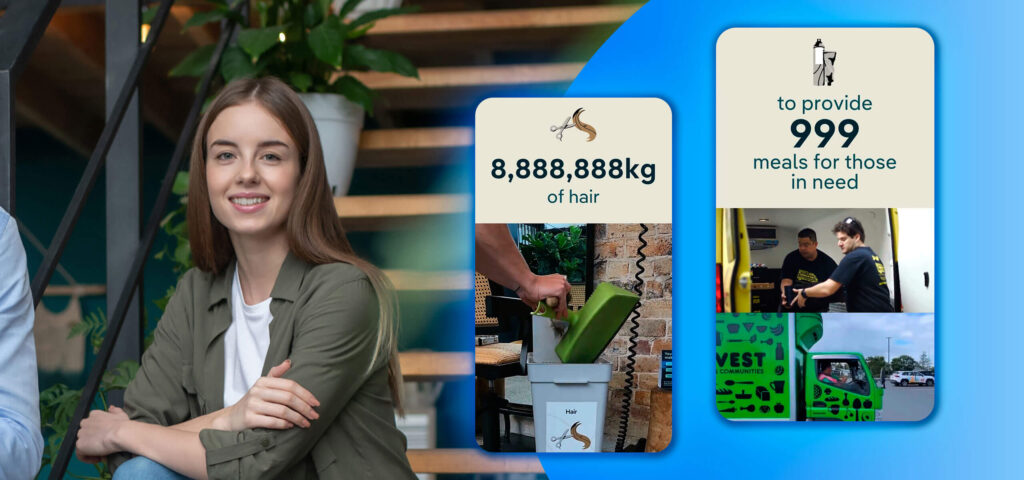
Sustainable Salons is a profit-for-purpose organization in Australia and New Zealand. It helps salons and related businesses reduce waste and create environmental impact.
The organization had meaningful member impact data. But the team needed members to understand that impact in a more personal and shareable way.
Static assets and reports were useful, but they were not enough to tell the full personal story.
The campaign used four audience segments, with an average of seven personalization fields per template.
Depending on the segment, the personalized data included fields such as account name, year of membership, kilograms of hair, litres of chemicals, metals, plastics, kilograms of paper, number of trolleys, number of trees, and other impact-related fields.
Sustainable Salons used Canva for the creative foundation. Pirsonal’s Professional Services helped turn the creative and structured member data into personalized videos and personalized landing pages. This is also part of our commitment to clients.
Each member could watch their own impact story, see their account reflected in the experience, and download the video to share with their network.
In Sustainable Salons’ case, the campaign was designed to engage an audience of around 1,500 members. Within the first five days, hundreds of members shared their personalized impact videos.
Pirsonal also supports larger campaign audiences, including campaigns with 20,000+ personalized videos and beyond, when the use case, data, and delivery model require it.
What made the campaign work
The campaign worked because each member could see their own role in the story.
It did not only say:
“Sustainable Salons is creating impact.”
It helped each member see:
“This is the impact we helped make possible.”
That is the difference between a generic impact message and a personalized experience that members want to use.
What Should You Prepare Before Contacting a Personalized Video Platform?
You do not need to have everything solved before speaking with a personalized video platform.
But the more clarity you have, the faster the right team can help you evaluate whether the idea is realistic, useful, and worth building.
Campaign strategy inputs
Prepare:
- campaign goal
- audience
- segments
- business objective
- desired action
- success metrics
- delivery channel
- launch timing
- internal stakeholders
Useful questions:
- What should the audience understand?
- What should they feel?
- What should they do next?
- What does success look like?
- How will the campaign be distributed?
Data inputs
Prepare:
- sample CSV or data export
- available fields
- required fields
- optional fields
- data owner
- missing value rules
- fallback values
- privacy or compliance requirements
- data retention expectations
Useful questions:
- Which fields are reliable?
- Which fields are meaningful?
- Which fields should not be used?
- What happens if a field is empty?
- Who can approve the final data file?
Creative inputs
Prepare:
- existing Canva, After Effects, Premiere, PowerPoint, or brand assets
- brand guidelines
- desired format
- example videos or styles
- copy direction
- voiceover or music requirements
- landing page copy or direction
- CTA copy
Useful questions:
- Do we already have a visual direction?
- Do we need a new creative concept?
- Should the video be vertical, horizontal, or both?
- Will the video be downloaded, shared, embedded, or viewed on a landing page?
- Does the campaign need personalized landing pages?
Security and delivery inputs
Prepare:
- preferred delivery channel
- whether videos should be public, private, or access-controlled
- whether landing pages are needed
- data sensitivity level
- privacy or compliance requirements
- hosting preferences
- access control expectations
- data retention expectations
- internal security reviewers
Useful questions:
- Where should the videos be hosted?
- How should recipients access the experience?
- Should URLs be public, private, anonymized, or protected?
- Are there internal security or compliance requirements?
- Does the campaign involve sensitive customer, member, employee, student, or financial data?
Approval and QA inputs
Prepare:
- approval owner
- data review owner
- creative review owner
- test recipients
- internal reviewers
- legal or compliance review if needed
- launch timeline
- final QA process
Useful questions:
- Who approves the message?
- Who approves the data?
- Who approves the final videos?
- Who verifies links, CTAs, landing pages, and fallback values?
- Who signs off before launch?
If you have the idea but are unsure whether your data, creative assets, timeline, or delivery model are ready, Pirsonal can help you evaluate the fit before production.
Make Sure Your Campaign Is Ready Before You Talk to a Vendor
A Spotify Wrapped-style campaign can be a great idea. But if the goal, data, creative assets, CTA, security needs, and approval process are unclear, the project can slow down quickly. Use this checklist to see what you already have, what is missing, and what a personalized video vendor will need to know before giving useful advice. Download the checklist and prepare your campaign with more confidence.
How Pirsonal Helps Teams Build Personalized Recap Campaigns
A Spotify Wrapped-style campaign is not only a creative project. It is a strategy, data, creative, delivery, and QA project.
Pirsonal helps teams turn customer, member, partner, donor, student, employee, or impact data into personalized video experiences that are clear, on-brand, secure, and ready to launch.
Depending on the campaign, Pirsonal can help with:
- campaign fit evaluation
- personalization strategy
- data structure and field planning
- dynamic video template creation
- creative adaptation from Canva, After Effects, Premiere, PowerPoint, or existing brand assets
- personalized video generation
- personalized landing pages
- interactive video CTAs
- campaign QA
- analytics and reporting
- secure hosting and delivery options
- custom workflows for larger or more complex campaigns
This matters because many teams do not fail because they lack data. They fail because the data, creative, message, delivery channel, and next action are not connected.
Pirsonal helps connect those pieces so the experience feels personal to the viewer and manageable for the team.

When a Spotify Wrapped-Style Campaign Is Not the Right Fit
As you now know, a Spotify Wrapped-style campaign can create attention, recognition, and action. But it is not always the right choice.
A campaign may not be right if:
- the data is unreliable
- the audience will not care about the data, story or context
- there is no next action
- the message is not important enough
- the team only wants to copy a trend
- the timeline does not allow proper QA
- nobody owns data accuracy
- no secure or appropriate delivery path is available
- a PDF, report, email, or landing page would already create enough understanding and action
- the campaign does not connect to a business goal
Remember, the best campaigns start with a meaningful message, not a format.
If a simpler format will help the audience understand and act, use the simpler format.
If the audience needs personal relevance, recognition, context, and a clear next step, a personalized video campaign may be worth exploring.
The Final Decision: Are You Delivering Data or Creating Recognition?
Before creating a Spotify Wrapped-style campaign, ask one final question:
Are we delivering data, or are we creating recognition?
Data delivery says:
“Here is the information.”
Recognition says:
“Here is what this means for you.”
Reporting says:
“Here is what happened.”
A personalized recap says:
“Here is what you helped make happen.”
If the message only needs to be documented, a report may be enough.
If the message needs to be understood, felt, shared, or acted on, a personalized recap campaign may be a better fit.
Again, the goal is not to make a trendy campaign. The goal is to make important information easier to understand, easier to feel, and easier to act on.
That is where personalized video can help.
If your team has member, partner, customer, donor, employee, student, or impact data that people need to understand and act on, Pirsonal can help you evaluate whether a Spotify Wrapped-style personalized video campaign is the right fit.
Turn Important Data Into a Campaign People Understand and Act On
Your team may already have the data. The challenge is turning it into a clear, relevant story your audience actually understands.
Pirsonal helps you turn member, partner, customer, donor, employee, student, or impact data into personalized video experiences — with the strategy, templates, landing pages, security options, and expert support needed to launch with confidence.
If the message matters, don’t leave it trapped in a report.
Talk to a Pirsonal expert today.
Frequently asked questions
- How to create a Spotify Wrapped-style campaign: Plan the data, story, creative, and sharing experience.
- Sustainable Salons personalized video case study: See how one member-based organization used personalized impact videos in practice.
- Personalized year-in-review video campaigns: Explore how Pirsonal helps teams turn customer, member, or partner data into personalized recap videos.
- Talk to a Pirsonal expert: Review your campaign idea, data, and next steps with our team.